Glendalough
Glendalough, the Valley of the Two Lakes, is one of the finest early Christian sites in Ireland and a highlight of a private
Wicklow day tour from Dublin.
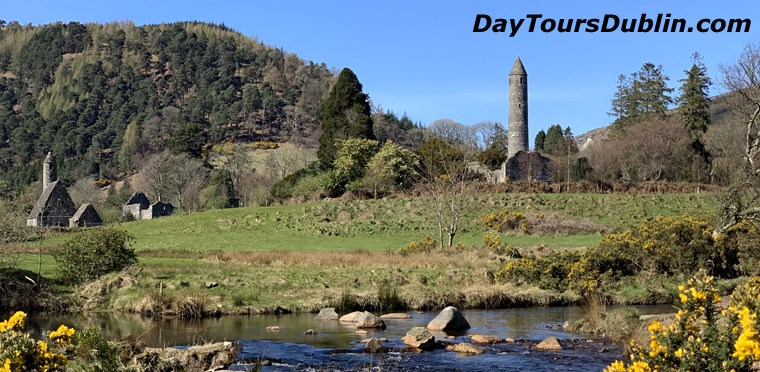
Glendalough monastic site in the Wicklow Mountains, founded by St Kevin in the 6th century.
Glendalough is renowned for its Early Medieval monastic settlement founded in the 6th century
by St Kevin. His fame as a holy man spread and he attracted numerous followers.
He died in about 618. For six centuries afterwards, Glendalough flourished and the
Irish Annals contain references to the deaths of abbots and raids on the settlement.
The destruction of the settlement by English forces in 1398 left it a ruin but it continued
as a church of local importance and a place of pilgrimage.
The buildings which survive probably date from between the 10th and 12th centuries.
The Gateway to the monastic city of Glendalough is one of the most important monuments,
now totally unique in Ireland. It was originally two-storied with two fine, granite arches.
The antae or projecting walls at each end suggest that it had a timber roof. Inside the gateway,
in the west wall, is a cross-inscribed stone. This denoted sanctuary, the boundary of the area of refuge.
The paving of the causeway in the monastic city is still preserved in part but very little remains of the enclosure wall.
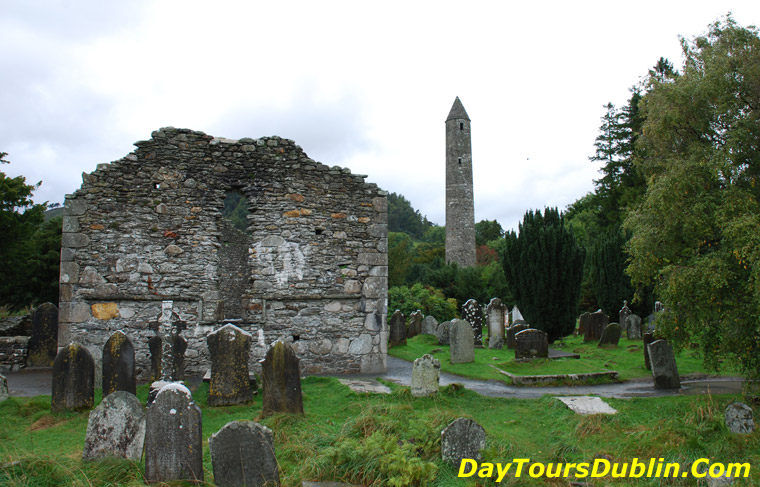
Glendalough monastic settlement founded in the 6th century by St Kevin.
The Round Tower built of mica-slate interspersed with granite is about 30 meters (98 feet) high,
with an entrance 3.5 meters (11.5 feet) from the base. The conical roof was rebuilt in 1876 using
the original stones. The tower originally had six timber floors, connected by ladders.
The four stories above entrance level are each lit by a small window; while the top
story has four windows facing the cardinal compass points. Round towers, landmarks
for approaching visitors, were built as bell towers, but also served on occasion
as store-houses and as places of refuge in times of attack.
The Cathedral is the largest building at Glendalough. It was built in several phases.
The earliest work is the present nave, with its antae.
The large mica-schist stones up to the square-headed west doorway were reused from an earlier smaller church.
The chancel and sacristy date from the late 12th and early 13th centuries.
The chancel arch and east window were finely decorated, though many of the stones are now missing.
The north doorway of the nave also dates from this period.
Under the southern window of the chancel are an ambry or wall cupboard and a piscina used for washing the sacred vessels.
A few meters (several yards) south of the cathedral stands an early granite cross with an unpierced ring, commonly known as St. Kevin's Cross.
Suggested day tours
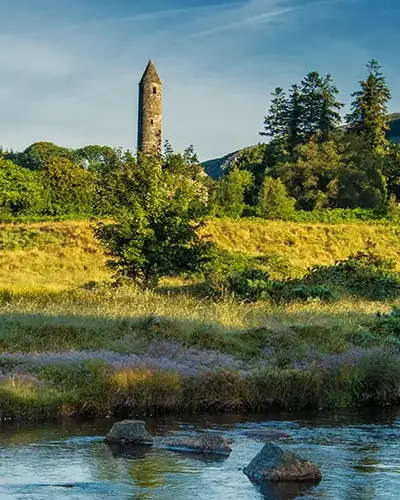
About 8 hours · Private
A mountain day south of Dublin combining Sally Gap viewpoints, the scenery above Lough Tay,
and the early Christian remains at Glendalough, with time for short walks and photography stops.
Price €700 for up to six guests, plus booking fees. Admission fees are extra.
TripAdvisor Reviews
We visited the beautiful Wicklow mountains and the ancient monastic settlement in Glendalough. All along the way, Michael enriched our visit by sharing his knowledge of the geography and history of the area.
Read the full TripAdvisor review
Loved our tour of the Wicklow Mountains and beyond with Michael Fox. Michael picked us up from our hotel and treated us to a perfect day with historic sites, celtic crosses, beautiful Manor houses and gardens.
Read the full TripAdvisor review