The Boyne Valley lies about an hour north of Dublin and holds some of Ireland's greatest ancient monuments.
A private day tour includes pickup from your Dublin hotel, the airport or a cruise terminal,
a local driver-guide, and an itinerary shaped around the places you most want to see.
Each tour below is priced per vehicle for up to six guests.
A classic first visit north of Dublin, centered on the Brú na Bóinne UNESCO landscape.
Official guided access to Newgrange and Knowth can be paired with the Hill of Tara, the Hill of Slane,
and the stories that connect ancient kingship, myth and early Christianity in the Boyne Valley.
Price €700 for up to six guests, plus booking fees. Admission fees are extra.
Built around medieval atmosphere and fine stone ruins, this private route visits Trim Castle, Mellifont Abbey,
Bective Abbey and the high crosses at Monasterboice, with flexible time for photography, abbey walks and local history.
Price €700 for up to six guests, plus booking fees. Admission fees are extra.
A deeper day among Ireland's great Stone Age monuments. After Newgrange and Knowth with the official guides,
the itinerary can continue to quieter prehistoric sites such as Dowth and Fourknocks at an unhurried pace.
Price €700 for up to six guests, plus booking fees. Admission fees are extra.
Brú na Bóinne is Ireland's best known prehistoric landscape, a UNESCO World Heritage Site of passage tombs, megalithic art and solar alignments.
Around it lie the ceremonial hills of Tara and Slane, medieval Trim, early Christian monasteries and Cistercian abbeys, all within easy reach of Dublin on a private day tour.
Tours can also be tailored around themes such as megalithic, Celtic or monastic sites,
traveling in a sedan for up to three guests or a Mercedes MPV for families and small groups.
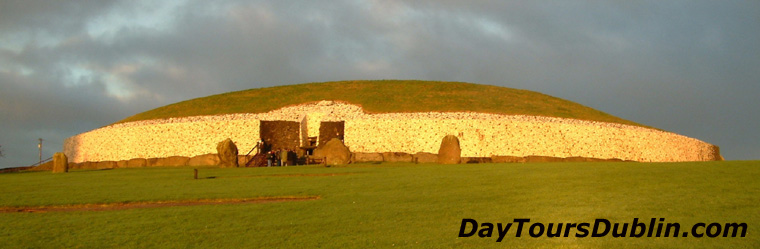
Newgrange
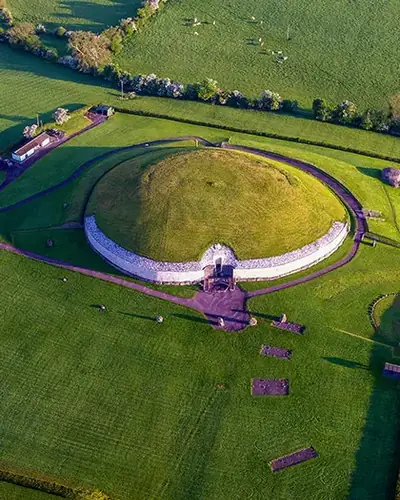
Newgrange is the best known monument of Brú na Bóinne, built around 3200 BC, centuries before the main pyramids at Giza and the great stone phase of Stonehenge.
The passage tomb is surrounded by 97 kerbstones, including a famous entrance stone covered in spirals and other designs. Inside, a long passage leads to a chamber that branches three ways.
The chamber has a corbeled stone roof that remains watertight. The entire cairn is estimated to contain about 200,000 metric tons of material. At dawn on the winter solstice, a shaft of sunlight enters through an opening above the doorway and lights the chamber.
Visits are by official timed ticket from the Brú na Bóinne Visitor Centre, with a shuttle bus to the monument.
Newgrange, a UNESCO World Heritage Site in the Boyne Valley.
Knowth
Knowth lies to the west of Newgrange. Its large mound covers two passage tombs placed back to back and is surrounded by 127 massive kerbstones, with 19 smaller tombs around the main mound.
More than three hundred decorated stones make Knowth the greatest concentration of megalithic art in Western Europe, with recurring motifs of circles, serpentine forms and spirals.
The site remained in use for centuries afterwards, as a burial place in the Bronze and Iron Ages, a royal center in the early medieval period, and later a manor farmhouse.
Like Newgrange, Knowth is visited on the official Brú na Bóinne tour.
Dowth
Dowth is the quieter of the three great passage tombs of Brú na Bóinne, yet it is comparable in size to Newgrange and Knowth.
The mound is surrounded by a kerb of 115 stones and contains two west-facing tombs. On the winter solstice, the setting sun lights the southern passage,
a sunset counterpart to the famous sunrise at Newgrange. At least thirty-eight stones carry megalithic art, with circles among the most common motifs.
There is no access to the interior, but visitors can walk around the mound, look for decorated kerbstones, and enjoy wide views across the River Boyne.
Fourknocks
Fourknocks is a Neolithic passage tomb built about 5,000 years ago, about 16 kilometers (10 miles) southeast of Newgrange between Ardcath and the Naul.
The name may come from the Irish for cold hills. Fourknocks offers a quieter visit, with a surprisingly spacious chamber and decorated stones that include a possible depiction of a human face.
Excavations in the 1950s found the tomb largely intact, with the remains of dozens of people and grave offerings such as stone beads, bone pins and miniature hammer pendants.
On a private tour, access to the chamber can be arranged, making this one of the most memorable quieter stops in the valley.
Hill of Tara
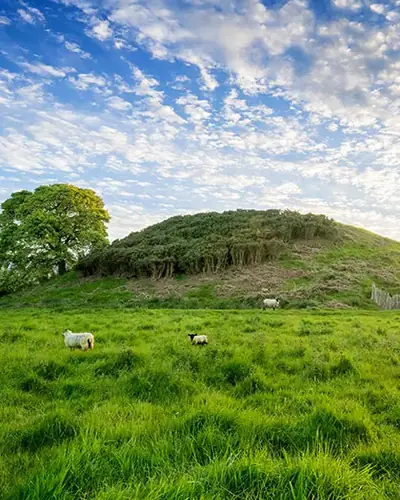
The Hill of Tara has been a place of burial and assembly for more than 5,000 years and is remembered as the legendary inauguration site of the High Kings of Ireland.
From its slopes there are views toward Loughcrew, the Hill of Slane, Trim Castle and much of the Boyne Valley. The oldest visible monument is Dumha na nGiall, the Mound of the Hostages, a passage tomb dating from around 3000 BC.
Tara grew in importance in the Iron Age and early Christian period as the royal center of Mide, the middle kingdom. Rath na Rí, the Fort of the Kings, encircles the summit, while the Lia Fáil, the Stone of Destiny, stands within the Forradh and is associated with royal inauguration.
Hill of Slane
The Hill of Slane rises about 158 meters (518 feet) above sea level and can be seen from Tara, about 16 kilometers (10 miles) away.
Legend says that in 433, in defiance of the pagan High King Laoghaire at Tara, Saint Patrick lit a Paschal fire here. Though angry, the king is said to have been so impressed by Patrick's devotion that he allowed him to continue his missionary work.
The hilltop holds the ruins of a Franciscan monastery dating from 1512, built on the site of an earlier foundation associated with St Erc, a follower of Patrick, along with a well-preserved tower and the remains of a college.
The views across the Boyne Valley make it a natural stop on a private tour.
Monasterboice
Monasterboice, from the Irish Mainistir Bhuithe, is an early Christian settlement associated with St. Buithe, known for its round tower and high crosses.
It stands in County Louth, just north of Drogheda, and remained an important center of religion and learning until Mellifont Abbey was founded nearby in 1142.
Visitors find two later churches and a well-kept graveyard.
The site is most famous for its tenth-century high crosses, especially Muiredach's Cross, about 5.5 meters (18 feet) tall and widely regarded as the finest high cross in Ireland,
with biblical scenes from both the Old and New Testaments. The West Cross is among the tallest in the country.
Kells
Kells, from the Irish Ceanannas Mór meaning great residence, was a royal site long before it became a monastic town.
St Columba, also known as St Colmcille, established a religious settlement here around 550, and later the community of Iona was granted lands at Kells as a safer home after Viking raids.
The town is closely associated with the Book of Kells, a richly decorated Latin gospel book written around the year 800.
What survives on the ground is the monastic heritage: a roofless round tower about 25 meters (82 feet) high, several finely carved high crosses, and St Columba's House,
a ninth-century stone church with a steeply pointed roof that is among the oldest buildings in the town.
The ninth-century Market Cross stands near the courthouse at the junction of the Navan and Slane roads.
Mellifont Abbey
Mellifont Abbey was the first Cistercian monastery in Ireland, founded in 1142 by St Malachy of Armagh with help from monks sent by St Bernard of Clairvaux.
It introduced a European style of monastic building to Ireland and became the model for later Cistercian houses, including Bective Abbey.
The most striking remains are the two-story octagonal lavabo, where monks washed before meals, along with the chapter house and gateway.
By 1170 the community numbered around one hundred monks and three hundred lay brothers. The abbey was closed in 1539.
Later still, the Treaty of Mellifont was signed here in 1603, and William of Orange used the site as headquarters during the Battle of the Boyne.
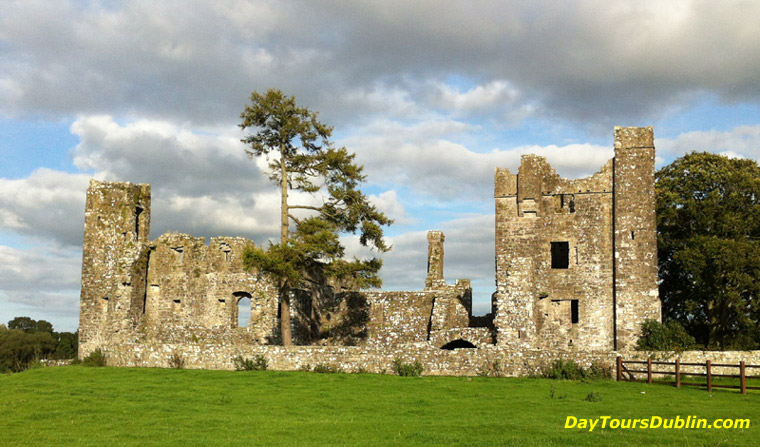
Bective Abbey
Bective Abbey was founded in 1147 for the Cistercian Order by Murchad O'Maeil-Sheachlainn, King of Meath, as Ireland's second Cistercian house and a daughter of Mellifont.
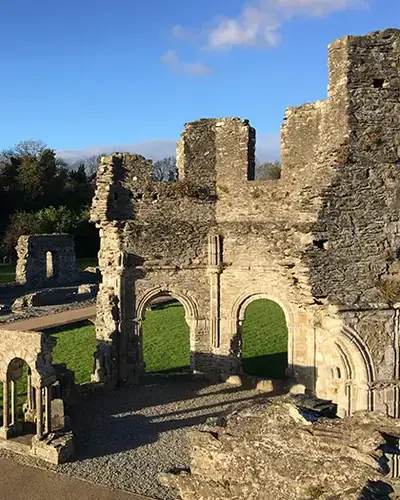
The visible ruins date mainly from the thirteenth to fifteenth centuries and include the church, chapter house and a well-preserved cloister with pointed Gothic arches.
After the Dissolution of the Monasteries in 1536 the buildings were adapted as a fortified house. Today the ruins form a maze of passageways, dead ends and interrupted staircases.
Archaeological excavations in 2009 to 2012 uncovered a large medieval barn, adding to the picture of monastic farming beside the River Boyne.
The abbey has also appeared on screen, including in Braveheart and Ridley Scott's The Last Duel.
Bective Abbey in the Boyne Valley.
Trim Castle
Trim Castle is the largest, best preserved and most impressive Anglo-Norman castle in Ireland.
Trim takes its name from Baile Átha Troim, the town of the ford of the elder trees, an important crossing of the River Boyne. Hugh de Lacy began a castle here in 1172 after Henry II granted him the Kingdom of Meath.
A first wooden fort was destroyed in 1174; the stone keep, curtain walls and moat that followed created a fortress covering about 1.2 hectares (3 acres), largely complete by 1220.
The twenty-sided keep, with walls 3 meters (10 feet) thick, is a striking example of experimental military architecture. In later centuries the castle guarded the northwestern edge of the Pale.
It has also appeared on screen, including as several locations in Braveheart.